

Running a credit repair business involves much more than sending dispute letters. You need a system that can help you manage clients, organize disputes, automate repetitive work, collect payments, and track progress from one place. That is where platforms like Credit Repair Cloud come in.
In this Credit Repair Cloud review, we will look closely at the software’s white label tools, dispute automation, CloudMail system, client management features, pricing, onboarding process, and overall workflow experience.
Credit Repair Cloud, often called CRC, is one of the most recognized credit repair CRM platforms in the United States. The software is designed for businesses that want to manage credit disputes, onboard clients, automate communication, and operate under their own branding using white label tools. Over the years, the platform has expanded beyond basic dispute management and now includes features like client portals, AI-assisted workflows, affiliate management, automation tools, reporting dashboards, and integrated payment systems.
According to Credit Repair Cloud, the platform is used by more than 20,000 businesses. However, software alone does not guarantee results, and choosing the right platform depends heavily on your workflow, compliance process, budget, and business goals.
In the sections below, we will break down Credit Repair Cloud in detail, including its features, pricing, white label capabilities, automation tools, limitations, and whether it is worth considering for your business.
Quick Summary
| Category | Rating |
|---|---|
| Ease of Use | 8.5/10 |
| White Label Features | 9/10 |
| Automation Tools | 8.5/10 |
| CloudMail Workflow | 9/10 |
| Scalability | 9/10 |
| Pricing Value | 7.5/10 |
| Beginner Friendliness | 8/10 |
| Overall Operational Depth | 9/10 |
Credit Repair Cloud is one of the most operationally complete platforms currently available for credit repair businesses in the United States. Instead of focusing only on dispute generation, CRC combines client onboarding, white label branding, CloudMail automation, CRM workflows, reporting systems, document management, team collaboration, and automation tools under one ecosystem.
The platform is best suited for businesses that want a centralized operational system rather than a lightweight dispute-only tool.
However, CRC may feel more advanced and expensive than necessary for businesses that only need basic dispute workflows or very small-scale operations.
| Active Users | Credit Score Points Increased | Processed |
| 20k | 196M+ | $229M+ |
What is Credit Repair Cloud?
Credit Repair Cloud is a cloud-based credit repair CRM platform designed for businesses that want to manage disputes, automate workflows, onboard clients, and operate under their own branding.
The platform is commonly used by:
- Credit repair businesses
- Mortgage professionals
- Financial consultants
- Entrepreneurs entering the credit repair industry
Unlike traditional dispute software, CRC combines client management, dispute workflows, automation tools, reporting, payment integrations, and white label features under one dashboard.
| Feature | Details |
|---|---|
| Platform Type | Cloud-based Credit Repair CRM |
| White Label Support | Yes |
| Client Portal | Included |
| CloudMail Automation | Yes |
| AI-Assisted Workflows | Available |
| Payment Integration | Supported |
| Team Collaboration | Included |
| Mobile Access | Browser-based |
| Free Trial | Available |
| Best For | Credit repair businesses and agencies |
One of the biggest reasons Credit Repair Cloud became popular is its white label structure. Businesses can use their own branding, client portals, onboarding flows, and communication systems while using CRC in the background.
Over the years, the platform has expanded beyond dispute management and now includes features like CloudMail automation, reporting dashboards, affiliate management, AI-assisted workflows, onboarding systems, and team collaboration tools.
According to Credit Repair Cloud, the platform is used by more than 20,000 businesses across the credit repair industry.
How We Evaluated Credit Repair Cloud
To create this Credit Repair Cloud review, we focused heavily on operational workflows instead of only surface-level feature lists.
Rather than evaluating CRC as a simple dispute letter tool, we reviewed how the platform functions as a complete credit repair business management system.
Our evaluation focused on areas such as:
- dispute workflow organization,
- credit report importing,
- CloudMail automation,
- white label functionality,
- client onboarding,
- operational scalability,
- CRM usability,
- dashboard experience,
- automation systems,
- team collaboration,
- document management,
- pricing structure,
- and overall workflow efficiency.
We also compared CRC against other commonly discussed credit repair platforms such as DisputeBee, WhiteLabelCRO, and ScoreCEO to better understand where Credit Repair Cloud stands operationally within the broader market.
Another major focus was usability for growing businesses. Instead of evaluating only individual features, we looked at how onboarding systems, dispute management, reporting, automation tools, communication workflows, and operational scaling function together inside the same ecosystem.
Since credit repair is a compliance-sensitive industry in the United States, we also considered broader operational responsibilities tied to automation, dispute workflows, and client management systems.
This review is designed primarily for:
- credit repair businesses,
- operational teams,
- agencies,
- mortgage professionals,
- and entrepreneurs evaluating CRC as a long-term workflow platform rather than simply a dispute generation tool.
Credit Repair Cloud Features
One of the biggest reasons Credit Repair Cloud became popular in the credit repair industry is the number of operational tools it combines under one platform. Instead of using separate software for dispute management, onboarding, client communication, automation, payment collection, and reporting, CRC attempts to centralize everything inside a single dashboard.
The platform is designed to reduce manual work while helping businesses organize day-to-day client workflows more efficiently.
Here are the core features of Credit Repair Cloud:
| Feature | What It Does |
|---|---|
| Credit Report Importing | Import and organize client credit reports |
| Dispute Automation | Create and manage dispute workflows |
| CloudMail | Print, mail, and track dispute letters |
| White Label Client Portal | Operate under your own branding |
| AI-Assisted Disputes | Help generate and organize disputes faster |
| Payment Integration | Collect payments directly through the platform |
| Client Onboarding | Automate intake and onboarding workflows |
| CRM Dashboard | Manage clients, disputes, and communication |
| Team Collaboration | Add staff members and manage workflows |
| Affiliate Management | Track referrals and affiliate activity |
| Reporting Tools | Monitor dispute progress and client activity |
| Automation Hub | Automate emails and workflow actions |
| Document Management | Upload and organize client files and IDs |
| API Access | Connect CRC with external systems and tools |
Unlike many smaller credit repair tools that focus only on dispute letters, Credit Repair Cloud is structured more like a complete business management system for credit repair companies.
For example, businesses can:
- onboard new clients,
- import reports,
- generate disputes,
- automate communication,
- collect payments,
- track progress,
- manage teams,
- and operate under their own branding without switching between multiple tools.
Another major advantage is that most of these features are connected together inside the same workflow ecosystem. This means onboarding, disputes, communication, CloudMail tracking, reporting, and client management are designed to work together rather than functioning as isolated tools.
In the next sections, we will break down the most important Credit Repair Cloud features individually, including dispute automation, CloudMail, white label tools, AI workflows, client portals, onboarding systems, reporting dashboards, and team collaboration features.
Credit Report Importing and Dispute Automation
One of the biggest operational problems for credit repair businesses is managing large amounts of client credit data manually. Importing reports, identifying negative items, organizing disputes, generating letters, and tracking responses can quickly become overwhelming as client volume grows.
Credit Repair Cloud attempts to simplify this process by centralizing dispute workflows inside a single dashboard.
With CRC, businesses can:
- Import client credit reports directly into the platform
- Organize accounts, inquiries, collections, and dispute items
- Generate dispute letters faster using templates and automation
- Process multiple disputes in batches
- Track bureau responses and dispute progress
- Upload supporting documents and client IDs
- Connect disputes with CloudMail for printing and mailing
One thing CRC does well is reducing repetitive administrative work. Instead of manually creating dispute records for every client, much of the workflow becomes structured automatically after importing reports.
The platform also includes a large dispute letter library that businesses can customize depending on the type of dispute being handled. This can save time for teams managing recurring monthly dispute cycles or larger client volumes.
Another major advantage is the integration between dispute management and other CRC tools. Imported reports, dispute workflows, CloudMail tracking, onboarding systems, and reporting tools are connected together instead of operating as separate systems.
Here is a quick video on how to import and run a credit audit:
CRC has also introduced AI-assisted workflows designed to help businesses organize disputes more efficiently. However, automation should still be reviewed carefully by the business handling the dispute process. Software can help organize workflows, but compliance, dispute accuracy, and supporting documentation still require human oversight.
For businesses that want a more centralized operational workflow instead of manually handling spreadsheets, templates, printing, mailing, and tracking separately, Credit Repair Cloud offers a significantly more organized system than many basic dispute management platforms.
CloudMail and Automated Dispute Mailing
One of the most heavily promoted features inside Credit Repair Cloud is CloudMail, a built-in system designed to automate the printing, mailing, and tracking of dispute letters.
Traditionally, many credit repair businesses handle disputes manually. This often involves:
- generating dispute letters,
- printing documents,
- organizing attachments,
- visiting mailing centers,
- tracking responses manually,
- and repeating the same process for multiple clients every month.
As client volume grows, this workflow can become extremely time-consuming.
CloudMail attempts to simplify this process directly inside the CRC ecosystem.
How CloudMail Works
After importing a client’s credit report and preparing disputes, businesses can:
- Select the dispute items
- Generate dispute letters
- Attach supporting documents if needed
- Choose mailing preferences
- Send disputes directly through CloudMail
The system is designed to handle:
- individual disputes,
- batch dispute processing,
- document printing,
- mailing automation,
- and dispute tracking from one dashboard.
This allows businesses to manage dispute workflows without switching between multiple external tools or handling large amounts of physical paperwork manually.

One feature many CRC users may find useful is batch dispute processing. Instead of preparing and mailing disputes individually for every client, businesses can organize multiple dispute workflows together. This can save a significant amount of administrative time for teams handling recurring dispute cycles.
CRC also allows some customization within the mailing workflow, including:
- mailing classes,
- document settings,
- print preferences,
- and supporting document attachments.
Another advantage is that CloudMail integrates directly with the broader CRC ecosystem. Imported reports, disputes, client records, onboarding workflows, and tracking systems remain connected throughout the process instead of operating as separate tools.
However, businesses should still understand that mailing automation does not remove compliance responsibility. Disputes still need to be reviewed carefully, supporting documentation should remain accurate, and businesses must ensure they comply with CROA, TSR, and other applicable regulations when handling client disputes.
For businesses managing larger client volumes, CloudMail can significantly reduce repetitive operational work compared to handling dispute printing, mailing, and tracking entirely manually.
White Label Features and Client Portal
One of the biggest reasons many businesses choose Credit Repair Cloud is its white label functionality. Instead of operating under another company’s branding, CRC allows businesses to present the platform as part of their own credit repair brand.
This is especially important for agencies and consultants that want a more professional client experience.
With Credit Repair Cloud, businesses can customize parts of the platform using:
- their own business name,
- branding elements,
- client communication,
- onboarding workflows,
- and client-facing portals.
This creates a more consistent experience for clients instead of directing them to unrelated third-party systems throughout the dispute process.

The client portal itself is designed to centralize communication and progress tracking. Clients can typically:
- review dispute progress,
- upload documents,
- access reports,
- monitor activity,
- and communicate with the business through a structured dashboard.
For growing credit repair businesses, this becomes much easier to manage compared to handling updates manually through spreadsheets, email chains, or disconnected tools.
Another advantage of CRC’s white label system is that it helps smaller businesses appear more operationally organized. Instead of piecing together multiple platforms for onboarding, dispute tracking, reporting, and communication, much of the workflow stays under one ecosystem.
CRC also includes affiliate and referral management tools that businesses can use alongside their branding workflows. This may be useful for companies that rely heavily on partnerships, referrals, or lead generation systems.
One thing worth noting is that while the white label functionality is useful, businesses still need to invest time into creating a professional onboarding experience, communication process, and operational workflow. The software provides the infrastructure, but branding quality and client experience still depend heavily on how the business itself is managed.
Compared to many smaller credit repair tools that focus only on dispute generation, Credit Repair Cloud places much heavier emphasis on helping businesses operate like a complete branded service rather than simply functioning as a dispute letter generator.
Credit Hero Score and Credit Monitoring
One area where Credit Repair Cloud expanded heavily over the years is credit monitoring and client score management. Instead of only focusing on dispute workflows, CRC also attempts to centralize score tracking, report monitoring, and client dashboard access inside the same ecosystem.
This is where features like Credit Hero Score become relevant.
Credit Hero Score is CRC’s integrated monitoring and score-tracking system designed to simplify how businesses and clients access credit information. The goal is to reduce some of the operational friction that traditionally exists when managing multiple client reports, monitoring updates, and tracking score-related activity.
One practical advantage is that businesses can access client monitoring workflows directly through the CRC ecosystem instead of relying entirely on disconnected third-party systems.
What Credit Hero Score Helps With
- Credit monitoring workflows
- Client score visibility
- Report importing and re-importing
- Tracking updated report activity
- Identity monitoring features
- Client dashboard access
- Centralized monitoring inside CRC
Here is how to access Credit Hero Score from your Credit Repair Cloud Dashboard:
One operational issue many credit repair businesses face is managing repeated report imports. In some workflows, newly updated reports may create duplicate entries, inconsistent account tracking, or confusion around deleted and re-added items.
CRC attempts to simplify this process by organizing report re-importing more cleanly within the platform ecosystem. Instead of manually restructuring every updated report, the system attempts to connect updated information more efficiently with existing client workflows.
Another noticeable improvement is centralized client access. Earlier operational workflows in the industry often required businesses to manually track multiple client usernames, passwords, monitoring portals, and disconnected systems.
CRC reduces some of this friction by allowing businesses to manage monitoring-related workflows more directly from the operational dashboard.
The platform also includes score simulation-style functionality that helps visualize how certain account changes may impact credit score behavior. While these simulations are not guarantees of actual score movement, they can still help businesses explain possible credit scenarios more clearly to clients.
At the same time, businesses should understand that credit monitoring tools are only one part of the broader credit repair process. Monitoring systems can help organize information and track changes, but dispute accuracy, compliance practices, documentation review, and operational quality still remain essential parts of the workflow.
Team Collaboration and Scaling Operations
As a credit repair business grows, operational management often becomes more difficult than the dispute process itself. Handling multiple clients, assigning responsibilities, monitoring progress, managing communication, and organizing workflows across a team can quickly become overwhelming without a centralized system.
Credit Repair Cloud attempts to solve this by including team collaboration and workflow management features directly inside the platform.
Instead of managing disputes, onboarding, communication, and operational updates through disconnected tools, CRC allows businesses to coordinate much of the workflow from one dashboard.
Team Management Features Inside CRC
- Multi-user team access
- Role-based operational workflows
- Shared client management
- Internal workflow organization
- Centralized dispute tracking
- Activity visibility across team members
- Workflow automation support
- Shared operational dashboard
One advantage of CRC’s structure is that onboarding systems, disputes, CloudMail workflows, client records, and reporting tools all remain connected together. This creates a more organized operational environment for businesses managing recurring dispute cycles or larger client volumes.
The platform also reduces some of the manual coordination problems that many growing businesses face when using spreadsheets, shared folders, disconnected email systems, and separate dispute tools simultaneously.
CRC’s team-oriented workflow becomes more useful once businesses begin:
- onboarding larger numbers of clients,
- handling recurring disputes monthly,
- assigning operational responsibilities,
- or scaling customer communication processes.
Another useful aspect is centralized visibility. Team members can review client activity, dispute progress, onboarding stages, and workflow updates without relying entirely on manual status reporting between staff members.
CRC also integrates automation workflows alongside team management systems, helping reduce repetitive operational tasks tied to onboarding, communication, and dispute handling.
At the same time, scaling operations through software still requires proper internal organization. Businesses need structured processes, operational oversight, compliance review systems, and clear communication standards regardless of the platform being used.
For growing agencies and operational teams, CRC’s collaboration ecosystem is one of the areas where the platform feels more like a complete operational CRM rather than a basic dispute management tool.
Document Management and Supporting Files
Credit repair workflows often involve much more than dispute letters alone. Businesses frequently need to handle supporting documents such as identification records, proof of address, account statements, bureau responses, and other client paperwork throughout the dispute process.
Managing these files manually across email chains, folders, and external storage systems can quickly become difficult as client volume increases.
Credit Repair Cloud attempts to simplify this by integrating document handling directly into the operational workflow.
What Businesses Can Manage Inside CRC
- Client identification documents
- Supporting dispute files
- Credit-related paperwork
- Uploaded client attachments
- Bureau-related documents
- Internal workflow files
- Organized client records
- Document access from centralized dashboards
One practical advantage is that supporting files remain connected to the client workflow itself instead of existing separately across disconnected systems. This makes it easier for businesses to organize dispute-related documentation alongside onboarding, disputes, communication, and reporting activity.
CRC also allows businesses to upload supporting documents during dispute workflows when additional verification or evidence is required.
In larger operational environments, this becomes especially useful because businesses may otherwise spend significant time searching through email attachments, cloud folders, or manually organized records to locate supporting files for active disputes.
Another operational detail CRC attempts to improve is document presentation. The platform includes tools that help businesses organize uploaded IDs and supporting files more cleanly before attaching them to dispute workflows.
For businesses handling recurring monthly disputes, centralized document management can reduce operational confusion significantly compared to manually managing paperwork across multiple disconnected systems.
At the same time, businesses still need to maintain proper security practices and handle sensitive client information responsibly. Credit repair workflows often involve personal financial data and identity-related documentation, which means businesses should prioritize secure operational processes regardless of the platform they use.
While document management may not be the most heavily marketed CRC feature, it plays an important role in making the broader workflow ecosystem feel more operationally centralized and easier to manage at scale.
User Experience and Dashboard Design
One thing that immediately stands out about Credit Repair Cloud is that the platform tries to organize a large number of operational tools inside a centralized dashboard instead of spreading workflows across disconnected systems.
Considering how many features CRC includes, dashboard organization becomes extremely important. Businesses are not only handling disputes, but also onboarding, communication, reporting, document management, automation workflows, CloudMail activity, payment systems, and client records simultaneously.
CRC’s newer interface updates have made the platform feel significantly cleaner and more modern compared to some of its older versions.
Areas the Dashboard Focuses On
- Client management
- Dispute workflows
- Credit report activity
- CloudMail tracking
- Automation tools
- Team collaboration
- Reporting visibility
- Onboarding systems
- Notifications and workflow updates
One practical advantage is that businesses can usually access most operational workflows without constantly switching between multiple external platforms. This creates a more centralized working environment, especially for teams managing recurring client activity daily.
The dashboard also attempts to surface important workflow information more clearly, including:
- dispute progress,
- client activity,
- onboarding stages,
- communication updates,
- and operational notifications.
Compared to older credit repair systems that often feel outdated or overly technical, CRC’s newer interface is noticeably more approachable for businesses entering the industry for the first time.
Another useful aspect is browser-based accessibility. Since CRC is cloud-based, businesses can access operational workflows from different systems without relying on traditional desktop software installations.
That said, the platform still comes with a learning curve.
Because CRC combines so many operational tools together, newer users may initially feel overwhelmed by the number of available workflows, dashboards, automation settings, and client management systems. Businesses planning to use the platform seriously will likely need time to understand how the ecosystem fits together operationally.
However, once the workflow structure becomes familiar, the centralized dashboard design can significantly reduce the operational friction that often comes from managing disputes, onboarding, reporting, communication, and documentation through multiple disconnected systems.
Batch Processing and Handling Larger Client Volumes
One of the biggest operational challenges for growing credit repair businesses is managing repetitive workflows at scale. Tasks like generating disputes, organizing reports, tracking client progress, updating records, sending communication, and handling recurring monthly workflows can become extremely time-consuming when handled manually for large numbers of clients.
This is one area where Credit Repair Cloud attempts to differentiate itself from simpler dispute-focused tools.
Instead of forcing businesses to repeat the same actions individually for every client, CRC includes batch processing and workflow organization systems designed to reduce repetitive operational work.
Where Batch Processing Helps
- Generating multiple dispute letters
- Organizing recurring dispute cycles
- Managing larger client volumes
- Sending communication workflows
- Updating operational records
- Handling recurring monthly tasks
- Processing disputes more efficiently across teams

For businesses handling dozens or hundreds of active clients, this type of workflow organization can significantly reduce administrative overhead compared to manually repeating every operational step separately.
One area where this becomes especially useful is recurring dispute cycles. Many businesses repeatedly manage similar workflows each month, including:
- importing updated reports,
- generating disputes,
- organizing supporting documents,
- tracking responses,
- and updating client activity.
CRC attempts to centralize these recurring workflows inside the same operational ecosystem instead of forcing businesses to rely heavily on spreadsheets, disconnected templates, or external tracking systems.
CloudMail integration also plays a major role here because businesses can connect batch dispute workflows directly with printing and mailing operations without manually processing every dispute separately.
Another operational advantage is visibility across workflows. Teams can monitor dispute progress, communication updates, and operational activity from centralized dashboards instead of manually tracking each stage through disconnected systems.
However, larger workflow automation still requires careful oversight. Businesses handling high client volumes should still review disputes properly, monitor operational accuracy, and maintain strong compliance procedures rather than relying entirely on automation systems alone.
For businesses planning to actively scale client operations, CRC’s batch workflow structure is one of the platform’s strongest operational advantages compared to many lightweight dispute management tools.
Training, Onboarding, and Business Resources
One thing that separates Credit Repair Cloud from many smaller credit repair platforms is that CRC is not positioned only as software. The company also places significant focus on onboarding, training, and business-oriented educational resources for people entering the credit repair industry.
For newer businesses, this can make the platform feel less like a standalone CRM and more like a broader operational ecosystem.
Educational and Onboarding Resources Included
- Platform onboarding guidance
- Credit repair workflow education
- Business setup resources
- Webinar-style training
- Automation walkthroughs
- Marketing and growth materials
- Operational guidance for new users
- Community-driven learning resources
Here is a quick video on how to schedule your onboarding call:
This educational layer can be especially useful for businesses that are unfamiliar with:
- dispute workflows,
- onboarding systems,
- operational organization,
- or client management processes.
Instead of simply providing software access and leaving businesses to figure everything out independently, CRC attempts to build supporting resources around the platform experience.
Another noticeable aspect is that many of CRC’s educational materials are tied directly into the operational workflow itself. Businesses are not only learning general credit repair concepts, but also how to use automation systems, onboarding flows, CloudMail workflows, client dashboards, and CRM tools together.
For some businesses, this creates a smoother learning curve compared to platforms that offer little operational guidance beyond basic software documentation.
CRC also promotes webinars, onboarding sessions, and community-oriented resources that attempt to help users understand both the software and the broader operational side of running a credit repair business.
At the same time, businesses should still approach educational content carefully and combine software guidance with proper compliance awareness, ethical operational practices, and independent business research.
Software training can help businesses understand workflows and systems more efficiently, but long-term success still depends heavily on operational quality, compliance practices, communication standards, and overall business execution.
For newer businesses entering the industry, CRC’s onboarding and educational ecosystem is one of the reasons the platform often feels more extensive than many lightweight dispute-only alternatives.
Credit Repair Cloud Pricing and Plans
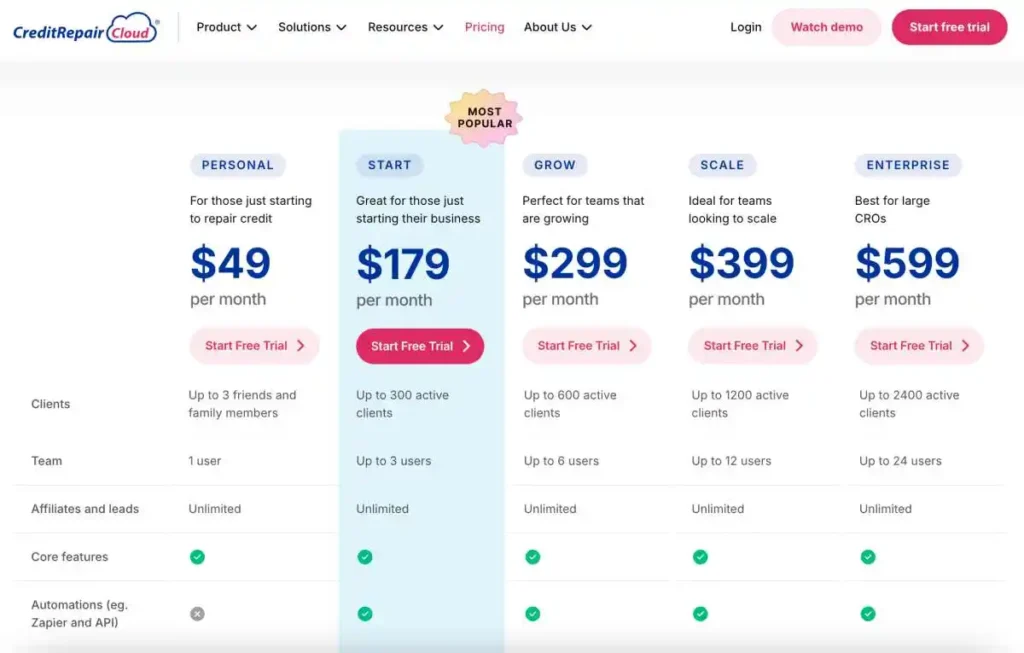
Credit Repair Cloud offers multiple pricing tiers depending on the size of the business, number of team members, and active client volume. Unlike many smaller dispute-only tools, CRC positions itself as a complete operational platform, which is reflected in its pricing structure.
At the time of writing, Credit Repair Cloud offers the following plans:
| Plan | Starting Price | Best For |
|---|---|---|
| Personal | $49/mo | Individuals learning the platform |
| Start | $179/mo | Small credit repair businesses |
| Grow | $299/mo | Growing teams and agencies |
| Scale | $399/mo | Larger operational teams |
| Enterprise | $599/mo | High-volume businesses |
CRC also offers annual billing discounts for businesses that commit long-term.
One thing worth noting is that most core platform features remain available across higher-tier plans, while the primary differences usually involve:
- active client limits,
- team member access,
- scaling flexibility,
- and operational capacity.
Which Credit Repair Cloud Plan is Best Suited?
Personal Plan ($49/mo)
Best suited for:
- Individuals exploring the platform
- Beginners learning credit repair workflows
- Users testing CRC before scaling operations
This plan is more educational and limited compared to the business-focused tiers.
Start Plan ($179/mo)
Best suited for:
- Small credit repair businesses
- Solo operators
- New agencies managing early client growth
The Start plan includes the core CRM, dispute workflows, white label tools, onboarding systems, and client management features most businesses need initially.
Grow Plan ($299/mo)
Best suited for:
- Small operational teams
- Businesses handling moderate client volume
- Agencies needing more staff access and scalability
This plan becomes more practical once multiple team members start managing disputes and onboarding workflows together.
Scale and Enterprise Plans ($399–$599/mo)
Best suited for:
- Larger credit repair operations
- High-volume client workflows
- Businesses managing larger internal teams
These plans focus more heavily on operational scaling, higher client capacity, and expanded team collaboration.
Credit Repair Cloud Pros and Cons
Like most large business platforms, Credit Repair Cloud has strengths in some areas and limitations in others. The platform offers a very broad operational ecosystem, but that also means it may not suit every type of business equally well.
One thing worth noting is that many of CRC’s strengths come from how much functionality the platform combines under one ecosystem. Businesses that want onboarding systems, CRM tools, dispute management, CloudMail automation, client portals, and workflow organization together may find the platform significantly more useful than simpler alternatives.
At the same time, smaller businesses looking only for basic dispute generation may not need the full operational ecosystem CRC provides.
This is why the platform tends to make more sense for businesses planning to actively build and scale structured credit repair operations rather than users looking for a minimal dispute-only workflow.
Who Should Use Credit Repair Cloud?
Credit Repair Cloud makes the most sense for businesses that want to actively build and scale structured credit repair operations instead of manually managing workflows across disconnected systems.
CRC is especially well-suited for:
- Growing credit repair businesses
- Agencies managing recurring monthly disputes
- Teams handling multiple active clients
- Businesses wanting white label functionality
- Companies need onboarding and CRM tools together
- Businesses looking for CloudMail automation
- Agencies want centralized operational workflows
- Teams planning long-term operational scaling
The platform becomes significantly more useful once client management, reporting, onboarding, communication, and dispute workflows start becoming difficult to organize manually.
Who May Prefer Simpler Alternatives?
While CRC is operationally extensive, not every business needs this level of workflow depth.
Some businesses may prefer lighter alternatives if they:
- only need basic dispute generation,
- manage very small client volumes,
- want lower monthly operational costs,
- prefer simpler dashboards,
- or do not need advanced automation and white label workflows.
For newer businesses testing the industry for the first time, the broader CRC ecosystem may initially feel more complex than necessary compared to lightweight dispute-focused platforms.
Credit Repair Cloud vs Alternatives
| Platform | Best For | White Label Tools | Automation Depth | Ease of Use | Best Suited For |
|---|---|---|---|---|---|
| Credit Repair Cloud | Full operational ecosystem | Excellent | Advanced | Moderate | Growing credit repair businesses |
| DisputeBee | Simpler dispute workflows | Limited | Moderate | Easy | Solo operators and smaller businesses |
| WhiteLabelCRO | Branding-focused operations | Strong | Moderate | Moderate | Agencies prioritizing white label workflows |
| ScoreCEO | Larger operational management | Strong | Advanced | Moderate | Scaling operational teams |
Credit Repair Cloud vs DisputeBee
DisputeBee is often considered by businesses looking for a simpler and more lightweight dispute management workflow.
Compared to CRC, DisputeBee generally focuses more heavily on:
- dispute generation,
- workflow simplicity,
- and lower operational complexity.
Businesses may prefer DisputeBee if they:
- manage smaller client volumes,
- want a faster learning curve,
- or do not need a broader CRM ecosystem.
However, CRC offers significantly more operational depth through:
- CloudMail,
- onboarding systems,
- white label portals,
- team collaboration,
- reporting workflows,
- automation systems,
- and centralized client management.
For businesses planning to scale operations long-term, CRC usually provides a more extensive ecosystem overall.

Write Dispute Letters that Work
Use DisputeBee, a professional credit repair software that automates the dispute writing process to create near-perfect and credible dispute letters.
Credit Repair Cloud vs WhiteLabelCRO
WhiteLabelCRO places much heavier emphasis on branded operational workflows and white label experiences.
Businesses evaluating WhiteLabelCRO often prioritize:
- custom branding,
- agency presentation,
- client-facing workflows,
- and white label operational structure.
CRC also supports white label functionality, but the broader platform ecosystem extends further into:
- automation,
- onboarding,
- CloudMail workflows,
- CRM management,
- dispute organization,
- and operational scaling.
Businesses focused heavily on white label presentation may still find WhiteLabelCRO appealing, while companies wanting a larger operational ecosystem may lean more toward CRC.
Credit Repair Cloud vs ScoreCEO
ScoreCEO is another operationally focused platform commonly evaluated alongside CRC.
Compared to lightweight dispute tools, both CRC and ScoreCEO focus more heavily on:
- CRM workflows,
- operational scaling,
- automation systems,
- and centralized management.
Businesses comparing the two often evaluate:
- dashboard structure,
- pricing flexibility,
- workflow organization,
- onboarding systems,
- and overall operational complexity.
CRC generally feels more ecosystem-oriented with stronger onboarding and educational resources, while some businesses may prefer ScoreCEO depending on workflow preference and operational style.
Which Alternative Makes the Most Sense?
The right platform depends heavily on the type of business being built.
Users looking for:
- centralized operations,
- onboarding systems,
- CloudMail workflows,
- automation,
- white label tools,
- and operational scaling support
will likely find Credit Repair Cloud one of the most complete ecosystems currently available.
On the other hand:
- lighter dispute workflows,
- simpler dashboards,
- or lower operational complexity
may prefer smaller alternatives depending on their operational needs and budget.
Compliance and Industry Considerations
Credit repair is a highly sensitive industry in the United States, and businesses using platforms like Credit Repair Cloud still need to follow federal and state-level regulations carefully.
While software can help organize disputes, automate workflows, and manage clients more efficiently, compliance responsibility ultimately remains with the business operating the service.
Credit repair businesses commonly need to consider regulations such as:
- The Credit Repair Organizations Act (CROA),
- Telemarketing Sales Rule (TSR),
- state-level credit repair laws,
- advertising guidelines,
- and consumer disclosure requirements.
For example, businesses should avoid:
- guaranteeing specific credit score increases,
- making misleading claims,
- charging prohibited advance fees where applicable,
- or presenting disputes inaccurately.
Platforms like Credit Repair Cloud provide operational infrastructure, but they do not replace legal, compliance, or professional oversight.
Another important consideration is that automation should still be reviewed carefully. AI-assisted workflows, dispute templates, automated communication systems, and batch processing tools can help reduce repetitive work, but businesses should still verify dispute accuracy, documentation, and compliance before submitting disputes to credit bureaus.
The broader credit repair software industry has also faced regulatory scrutiny in recent years, particularly around marketing practices, telemarketing, and fee structures. Because of this, businesses using any credit repair CRM platform should prioritize ethical workflows, transparent communication, and compliance-focused operations instead of relying entirely on automation.
For businesses entering the industry for the first time, it is often a good idea to combine operational software with proper legal guidance, compliance education, and clear client communication practices.
Is Credit Repair Cloud Worth It?
Credit Repair Cloud is one of the most feature-rich platforms currently available for businesses operating in the credit repair industry. Instead of functioning as a simple dispute letter generator, CRC attempts to centralize onboarding, dispute management, client communication, reporting, automation, white label branding, and operational workflows under one ecosystem.
For businesses planning to actively build and scale a structured credit repair operation, the platform offers significantly more operational depth than many lightweight dispute-only tools.
CRC may be worth considering if you:
- want a centralized CRM and dispute management system,
- plan to manage multiple active clients,
- need white label functionality,
- want automation tools for repetitive workflows,
- prefer cloud-based operational systems,
- or want onboarding and communication tools integrated together.
The platform becomes especially useful once client volume starts growing and manual workflows become harder to manage efficiently.
At the same time, CRC may not be the ideal fit for every business.
Smaller startups or individuals looking only for basic dispute generation may find the platform more expensive and operationally complex than necessary. Some businesses may also prefer simpler systems with fewer workflow layers if they do not need advanced automation, team collaboration, or scaling tools.
Another important factor is operational responsibility. While Credit Repair Cloud provides extensive infrastructure, automation, and workflow organization, the software itself does not guarantee business success or compliance. Businesses still need effective communication systems, ethical operational practices, compliance awareness, and proper dispute review processes.
Overall, Credit Repair Cloud makes the most sense for businesses that want a more complete operational ecosystem instead of piecing together multiple disconnected tools for onboarding, disputes, reporting, communication, and client management.
Also Check: Is Credit Repair Cloud Legit?
Video Testimonials: What Users Say About Credit Repair Cloud
The layout is super simple, it tells me everything I need to know, all the data points. It is super easy to import..
You put your information and everything just flows easily from there and the fact that the data feeds into my credit report, it just makes my job a lot easier.
Trustpilot Reviews:
Final Verdict: Credit Repair Cloud is the Best?
Credit Repair Cloud remains one of the most complete operational platforms currently available for credit repair businesses in the United States.
What makes CRC stand out is not just dispute management, but the broader ecosystem surrounding it. The platform combines CRM workflows, white label branding, client onboarding, CloudMail automation, reporting systems, AI-assisted tools, payment integrations, and operational management under one centralized dashboard.
For businesses planning to build a structured credit repair operation instead of relying on disconnected tools, CRC offers significantly more organizational depth than many smaller alternatives.
The platform is especially well-suited for:
- growing credit repair businesses,
- operational teams,
- agencies managing recurring dispute workflows,
- and businesses that want centralized client management alongside automation features.
At the same time, CRC may feel more advanced and expensive than necessary for smaller businesses that only need lightweight dispute generation tools. The broader ecosystem comes with a learning curve, and businesses still need proper compliance oversight, workflow management, and client communication practices regardless of the software they use.
Overall, Credit Repair Cloud is best viewed as a full operational system for managing and scaling a credit repair business rather than simply a dispute letter platform.
For businesses that want white label functionality, automation tools, workflow organization, and centralized client management under one ecosystem, Credit Repair Cloud remains one of the strongest platforms currently available in the credit repair software space.
Frequently Asked Questions [FAQs]
Credit Repair Cloud is more beginner-friendly than many traditional credit repair systems because it combines onboarding, dispute workflows, automation, and client management under one dashboard. However, newer businesses may still need time to understand the operational and compliance side of the industry.
Yes. CRC includes white label features that allow businesses to operate under their own branding, client communication system, and portal structure instead of presenting themselves as a third-party service.
CRC includes dispute automation tools, CloudMail workflows, batch processing, and AI-assisted features that help reduce repetitive administrative work. However, disputes should still be reviewed carefully for accuracy and compliance.
Yes. Credit Repair Cloud is a browser-based platform, which means businesses can access dashboards, disputes, onboarding systems, and client records online without installing desktop software.
Yes. CRC supports integrated payment workflows, allowing businesses to manage billing and payment collection directly through the platform ecosystem.
CRC is designed to support growing businesses and operational teams. Higher-tier plans allow additional team members, expanded client capacity, workflow collaboration, and centralized management tools.
No. Software platforms can help businesses organize workflows and automate operational tasks, but they cannot guarantee specific credit score improvements or dispute outcomes.
That depends on the type of business. CRC may feel expensive for businesses needing only basic dispute generation, but companies looking for a larger operational ecosystem with CRM tools, automation, onboarding, CloudMail, and white label functionality may find the pricing more justifiable.


